
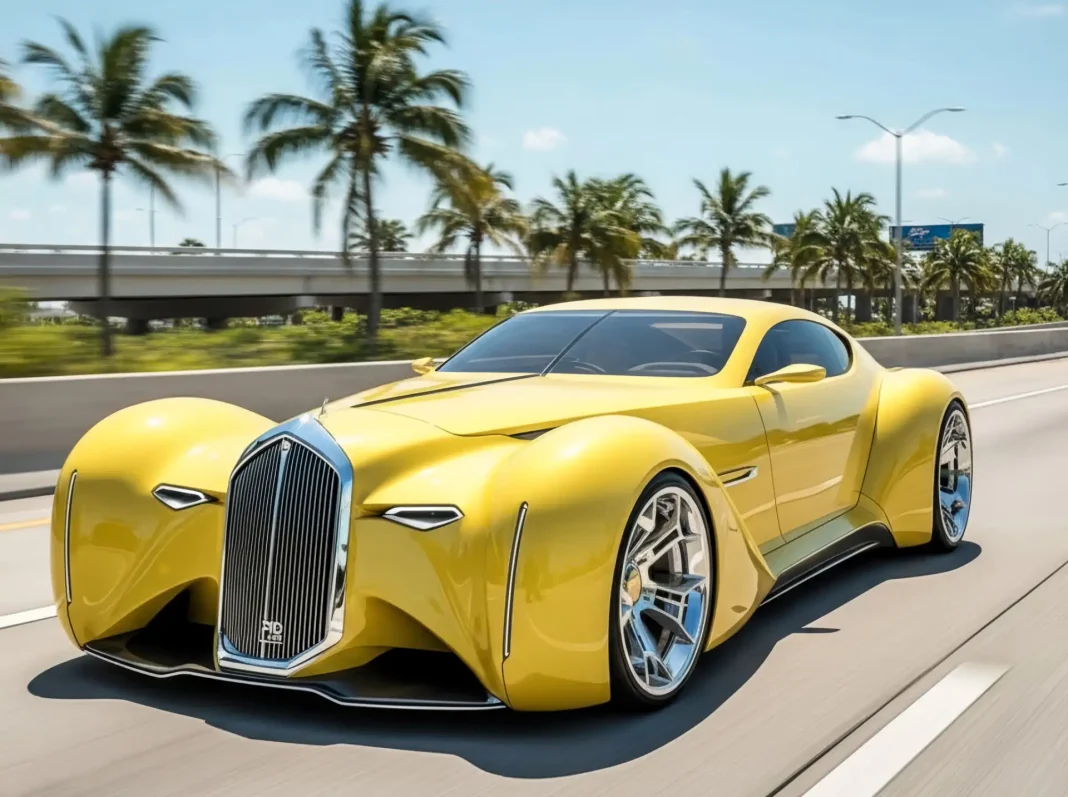
New digital design tools and AI have opened a portal to a parallel universe of automotive design. As imaginary cars become ever more realistic, they are throwing down the gauntlet to engineers and challenging the established automotive industry.
You’re flicking through Instagram or idly scrolling through Facebook when up pops a spectacular car, giving 1950s American vibes but with a distinctly futuristic edge. It has an evocative name like Canary, whose tweet turns into a roar when you discover what’s under the bonnet: a powerful 5.5-litre V10 engine. You search for it online, only to discover it doesn’t exist.
Something similar is happening in architecture. The Neocosmic style conjures up luxury spaces where imagination knows no bounds. They are spectacular, certainly, but also perfectly inhabitable. Alas, they too exist only online. In architecture, motoring and no doubt plenty of other fields, digital creation and artificial intelligence (AI) are making it increasingly difficult to tell where imagination ends and reality begins.
Car design has spilled out beyond the studios of automotive engineers and in-house design teams. Today, digital designers and creators such as Khyzyl Saleem, Rossty3D, Johnny Rush and Paynes switch between hand sketching, 3D modelling and AI to dream up vehicles that don’t exist but certainly look entirely plausible.
Their social media feeds are packed with reimagined classics, retromods, futuristic concept cars and even fictional manufacturers with identities of their own. The Canary 5.5L V10 is a perfect example. It looks as though it could quite easily have emerged from the workshop of a specialist coachbuilder. And once the idea is out there, who knows? Perhaps one day it actually will.
And if your first instinct is to Google one of these cars, or ask AI about it, simply because it looks too real not to exist, imagine the challenge this new digital world poses for the designers creating the cars that actually make it onto our roads. Perhaps it will even open the door to engineers bold enough to turn some of these fantasies into one-off commissions. As for the price? That’s a whole other story.