Wood, paper, books, lights or even a stepladder. New materials, structures and decorations are taking the Christmas tree beyond its traditional form. Every year brings fresh interpretations of one of the season’s best-known symbols.
A Christmas tree no longer needs to be an actual tree. In its forecast for Christmas 2026, Architectural Digest includes ‘unusual trees’, with the familiar conifer giving way to sculptural structures, suspended installations, carefully arranged books and other unexpected materials.
These reinterpretations are not entirely new. Publications such as House & Garden, Real Homes and Homes & Gardens have featured the growing number of alternatives to the traditional tree for a number of years now. The idea is not to do away with it, but to reinvent it.
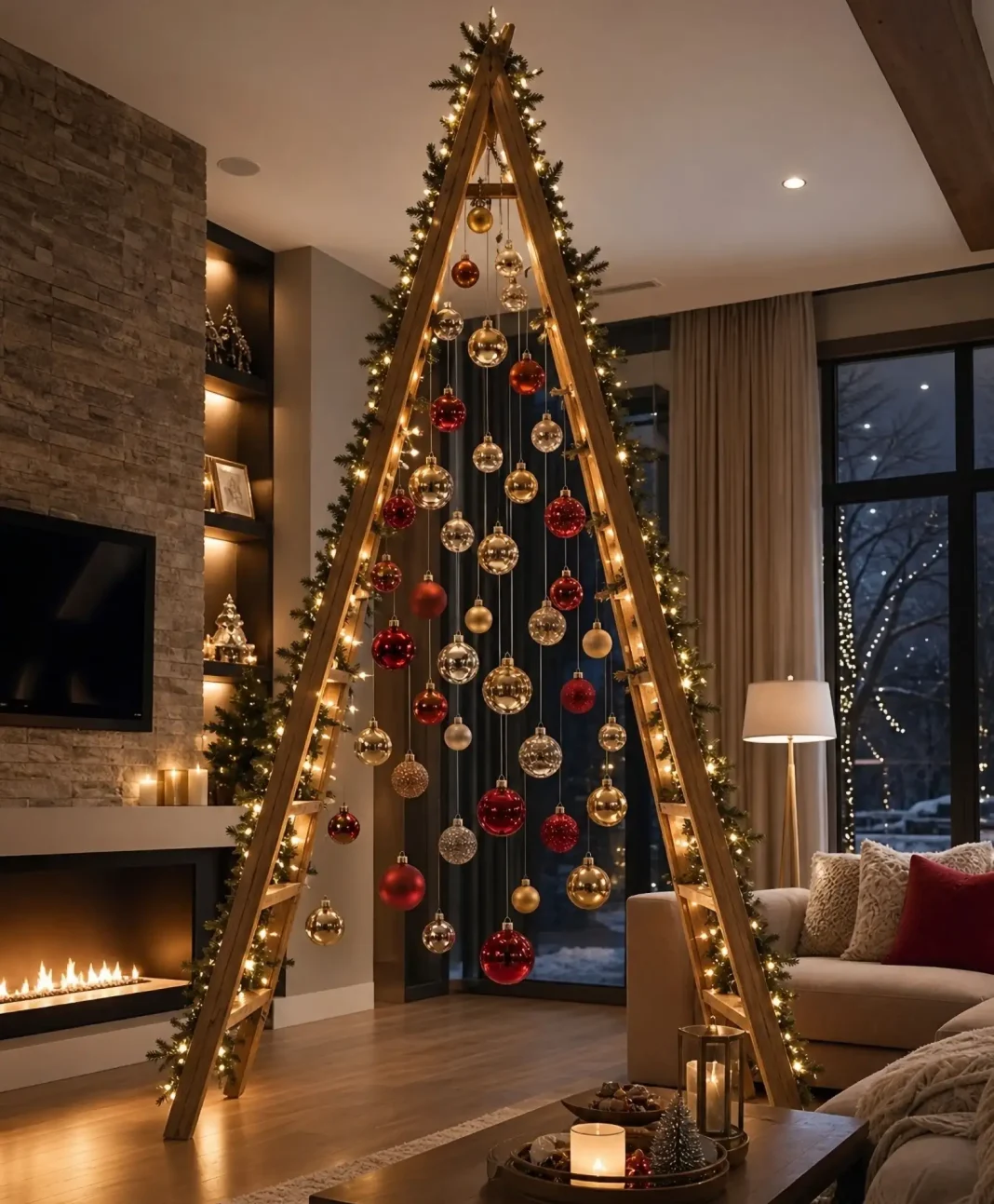
Lack of space, the desire to reuse materials, sustainability and a search for originality bring new possibilities every Christmas. Wooden slats and boards recreate the outline of a fir tree, while branches and logs offer a more organic version. Metal, glass and ceramics can also be shaped into tree-like forms. Trees can be built from books, paper and everyday objects, or even created from the triangular outline of an open stepladder. Others are two-dimensional and mounted on the wall, taking up almost no space at all.
What we hang from them is changing too. Baubles and stars now mingle with paper decorations, textiles, ribbons, handcrafted pieces and natural materials. A less conventional tree leaves more room for creative, unusual and surprising decorations, free from any rules about matching its materials or overall look.
The most pared-back versions need no hanging decorations at all. Materials, geometry and light serve as both structure and decoration. The reverse can also be true: objects suspended in mid-air trace the outline of a tree that does not physically exist. The line between structure and decoration begins to blur.
Meanwhile, the traditional fir tree is evolving too. ELLE Decor has recently highlighted ‘bow trees’, in which bows take centre stage as the main decorative feature. The Christmas tree is here to stay, but it is morphing far beyond branches and needles.