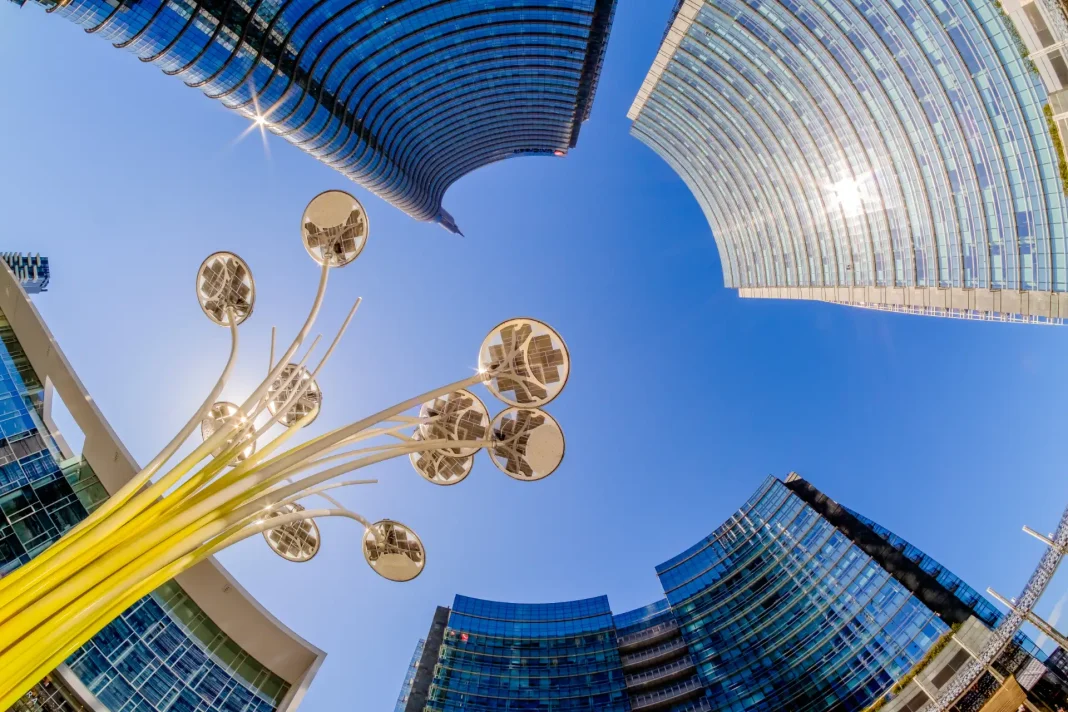
With glass façades, open squares and elegant lines reshaping the skyline, Porta Nuova is the new, distinctly contemporary face of Milan. Far more than a cluster of skyscrapers sharing the city with the Duomo and other iconic buildings, it is an entire district with a language all its own.
Porta Nuova is Milan’s flagship urban regeneration project. Built close to the heart of the Lombard capital on former railway and industrial land between the Garibaldi, Varesine and Isola neighbourhoods, this new financial and residential district has transformed a large area of disused land into offices, homes, shops, parks and spacious pedestrian zones. Milan has reclaimed a neglected part of the city and brought it back to life with a thoroughly contemporary vision and aesthetic.
In terms of scale and urban planning, Porta Nuova is often compared with major international developments such as Canary Wharf in London and La Défense in Paris. Like them, it has created a new skyline and become one of the city’s main centres of economic activity. The project received final approval in 2005, followed by almost two decades of development that shaped the urban landscape seen today. The completion of the Unipol Tower in 2023 marked the culmination of the project.
The transformation also reflects the evolution of Milan itself. The Duomo, La Scala, the Galleria Vittorio Emanuele II and the Quadrilatero della Moda now have a contemporary counterpoint: an architectural landscape looking confidently towards the twenty-first century. Porta Nuova does not compete with the historic city, but adds another dimension to Milan’s identity, bringing tradition, design, innovation and sustainability together within the same urban landscape.
Porta Nuova is not defined by a single architectural style, but its buildings speak a common language: transparency, clean lines, energy efficiency and a sense of belonging to a wider urban plan. Rather than a catalogue of architectural showpieces, it feels like a coherent district, shaped by a unifying vision that takes precedence over individual styles.
Designed by César Pelli, the UniCredit Tower has become the new icon of Milan’s skyline, while Stefano Boeri’s Bosco Verticale revolutionised residential architecture by incorporating hundreds of trees and thousands of plants into two towers that are now recognised the world over. Alongside them, Gioia 22 takes energy efficiency in office design to a new level, while the Unipol Tower is distinguished by its curved, lattice-like outer structure. Together, they demonstrate that contemporary architecture can be far more than a collection of striking individual buildings.