
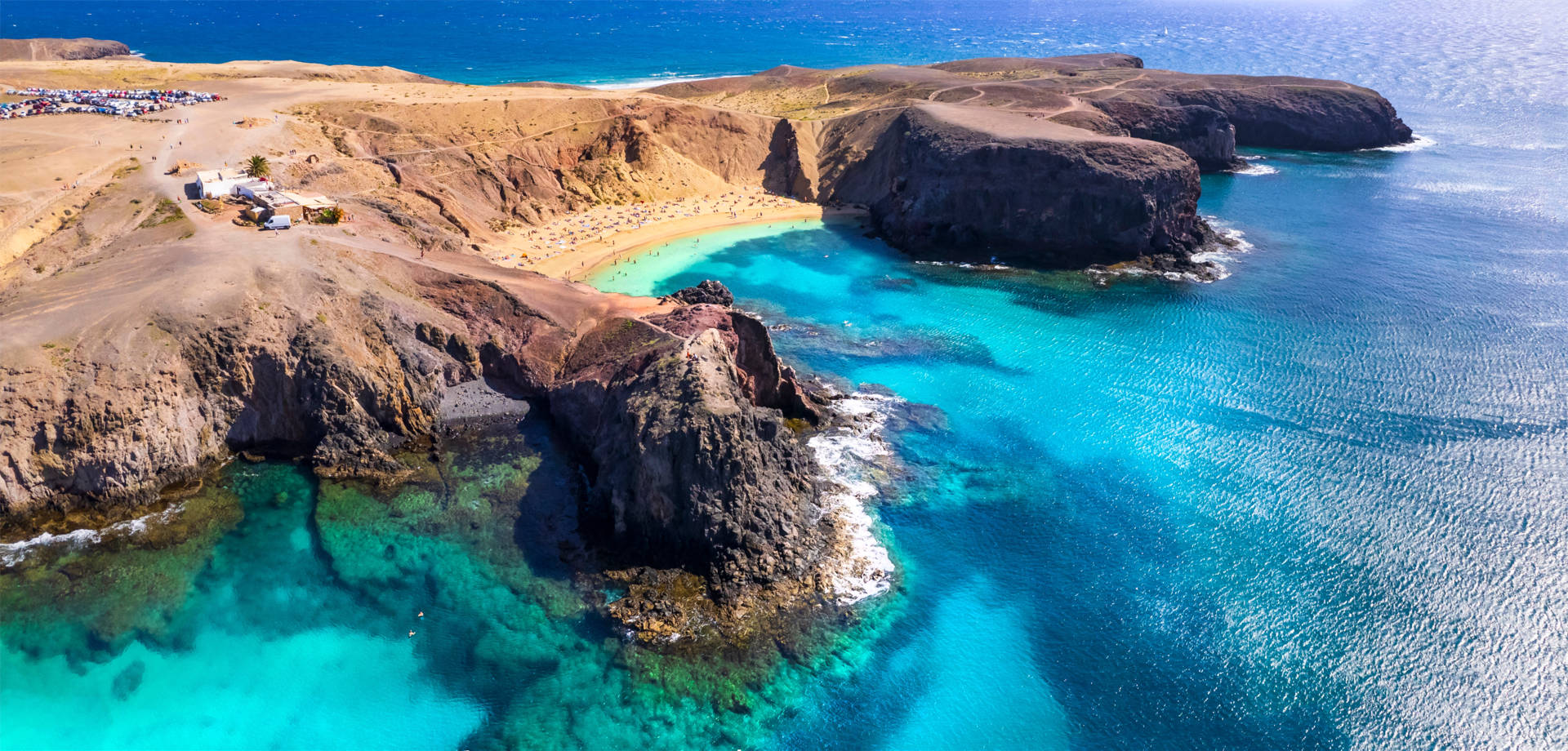
Papagayo is one of Lanzarote’s great revelations. At the island’s southern edge, where ancient lava landscapes dissolve into the Atlantic, a string of sheltered coves lies tucked away, waiting to be explored.
At the foot of Los Ajaches, Lanzarote’s oldest volcanic massif, and beyond an almost desert-like stretch of terrain, the coastline suddenly opens into a succession of golden beaches and crystalline waters sheltered by cliffs formed from ancient lava flows.
Just beyond Playa Blanca, the south’s principal resort town with its marina, hotels, restaurants and long seafront promenade, the coves of the Monumento Natural de Los Ajaches unfold one after another towards the southeast: Playa Mujeres, Caletón del Cobre, Caletón de San Marcial, Playa del Pozo, Playa de la Cera, Playa de Papagayo itself, Caleta del Congrio and Puerto Muelas. Each has its own character, though together they form one of the island’s most distinctive coastal landscapes.
The Ajaches massif is among the oldest geological formations in Lanzarote, carved and cracked by more than ten million years of erosion. Ancient lava flows, ravines, fossil beach levels, dunes and volcanic dykes remain clearly visible across the terrain, including the rock wall overlooking Papagayo cove itself, estimated to be around eleven million years old. All of it belongs to a landscape that still carries traces of a time when the sea reached heights now far above the shoreline.
The area also holds deep historical significance. Close to the present urban fringe lies the archaeological site of San Marcial del Rubicón, regarded as the first European settlement in the Canary Islands. Founded between 1402 and 1404, the site continues to be excavated and studied today. Wells, defensive structures, traces of dwellings, burials and the footprint of an early church all survive within the landscape.
A network of ten marked walking trails allows visitors to explore the area more closely, including paths connecting the beaches themselves. Unpaved tracks branching from the main road also lead down towards the various coves within the protected natural area, officially safeguarded as a Natural Monument since 1994.
Papagayo never quite reveals itself in the same way twice. Some days it is crowded and alive; on others, it feels almost untouched… fleeting, but precious moments. To discover it properly means pausing over the details: the changing colour of the water, the sharp contrasts of volcanic rock and the silence of the landscape itself. How you look at the landscape shapes what you find. Papagayo will always be there, in all its beauty. Whether you fall under its spell, rather, depends on you, and the moment you arrive.