
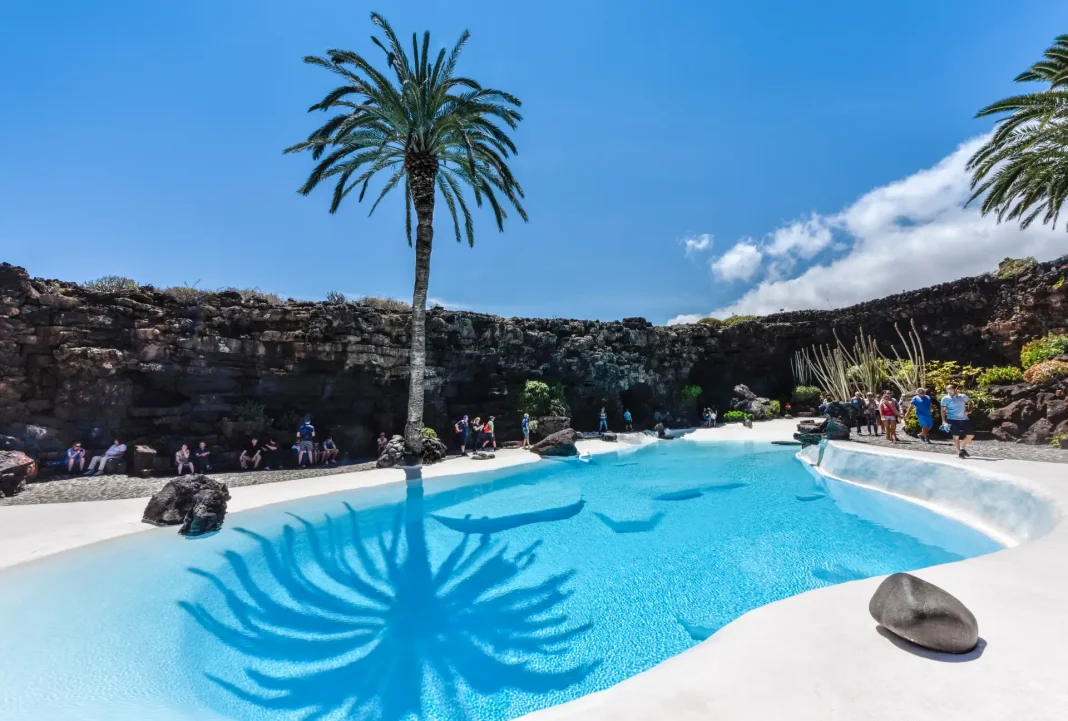
César Manrique’s first major project on Lanzarote also marked the beginning of a new way of working with the island’s landscape and shaping its tourism. More than half a century after it first opened, Jameos del Agua continues to bring together geology, art, science, tourism and culture.
The eruption of La Corona volcano between 18,000 and 21,000 years ago formed a lava tube approximately 7.7 kilometres long. As the lava cooled, sections of its roof collapsed, creating the cavity now occupied by Jameos del Agua. At its seaward end, the Túnel de la Atlántida extends for around 1,600 metres beneath the ocean, reaching a maximum depth of approximately 64 metres.
Out of an apocalyptic landscape of incandescent basalt emerged one of Lanzarote’s most emblematic sites, today defined by rock, water and light. Opened to the public in 1966, Jameos del Agua was César Manrique’s first major project on the island. In Manrique, the volcano found an artist who knew how to turn it into something new without changing its essence, creating a unique place where geology, art, tourism, culture and science exist in harmony.
This pioneering project would eventually give rise to the Cabildo de Lanzarote’s network of Art, Culture and Tourism Centres. During the 1970s, its celebrated dance floor and the music Manrique brought back from New York earned Jameos del Agua international fame, establishing it as one of the island’s leading visitor attractions.
Since it opened, Jameos del Agua has continued to evolve through successive conservation and improvement projects without compromising Manrique’s original vision. Alongside the pool framed by volcanic rock, the covered interior lagoon remains its greatest treasure. A walkway running along one side offers a view into its extraordinarily clear waters, while at high tide the lagoon can reach a depth of ten metres. It is home to the tiny blind albino crab (Munidopsis polymorpha), a species found nowhere else in the world. Over time, it has become the emblem of Jameos del Agua.
Another highlight is the auditorium, a magnificent venue created within a natural volcanic chamber. Its remarkable acoustics turn every performance into an unforgettable experience. Today, it is a fixture of Lanzarote’s thriving cultural life, hosting concerts, festivals and stage productions in which the setting itself becomes part of the show.
In 1987, the Casa de los Volcanes was added to Jameos del Agua as a museum and educational centre exploring the origins and geological evolution of the Canary Islands. The site also became home to one of the observation stations belonging to the Lanzarote Geoscience Laboratory, adding scientific research to its already remarkable combination of functions.