
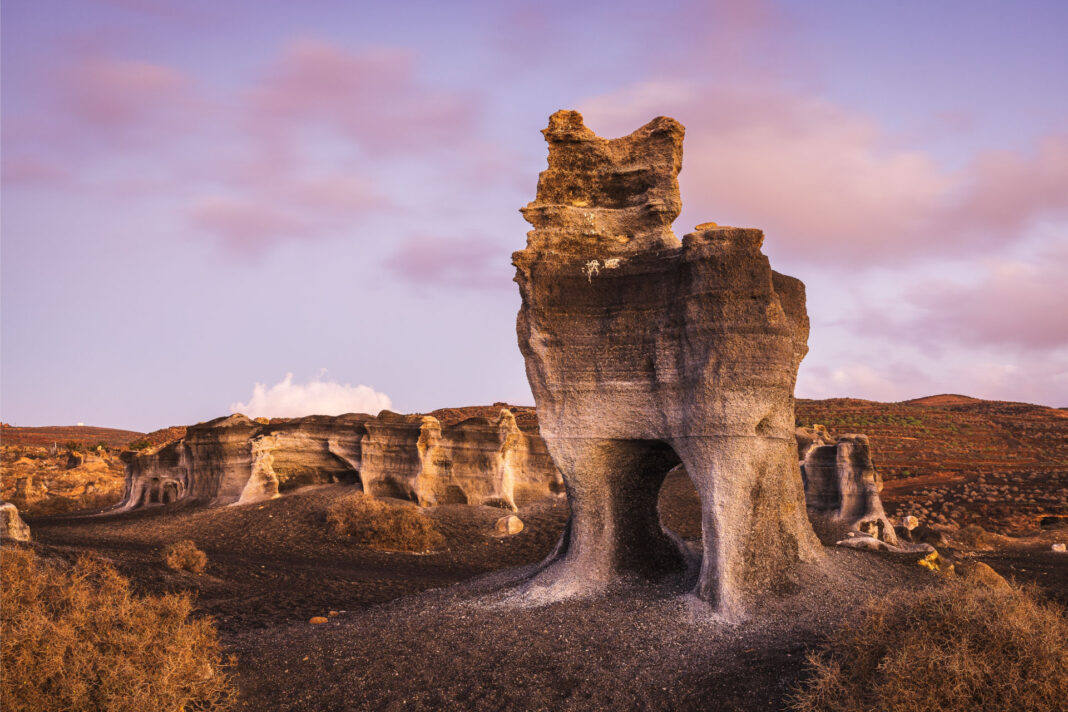
Roferas are volcanic gravel and sand quarries, but some, like the one in Teseguite, have been sculpted by wind and time into shapes that toy with light and shadow and invite the imagination to run riot.
The old Teseguite rofera, known locally as the ‘Stratified City’, lies on both sides of the road between Teguise and Los Valles, near the turn-off to Guatiza. Whilst not an official tourist spot— just an abandoned quarry that has been inactive for many years—it has earned a place on sightseeing itineraries for those wishing to immerse themselves in an otherworldly experience.
Parking is easy and free, but take care when leaving the tarmac, as the ground and paths are made of fine volcanic gravel, which is uncomfortable underfoot, so wearing closed footwear is best. You should also bring water and sun protection.
This fascinating geological site showcases the power of natural erosion on volcanic rock. In clusters or standing alone, the mounds have been shaped by wind, rain, and time to reveal their strata, round their edges, and carve out small caves. In shifting shades of grey and black, the landscape plays with passing cloud shadows, offering photographers locations as fantastical as they are otherworldly. It is constantly evolving, still being carved by the elements.
Sadly, they are susceptible not just to the elements, but also to vandalism and careless behaviour. These ash mounds can collapse if climbed, and even a moment’s thoughtlessness can cause irreparable damage. The site would benefit greatly from official recognition by the local government to provide active stewardship, including signage, conservation, and monitoring, which would help safeguard what is already a draw for visitors.
Teseguite is by no means the only rofera in Lanzarote, nor are these quarries unique to the island of volcanoes. Several can be found nearby, just inland near the Montaña de Guenia volcano. There are three others, distinct from this one, near the Tinamala volcano (Guatiza), located almost opposite the ‘Stratified City’, facing northeast toward the sea.
Another important rofera in Lanzarote is Lomo de San Andrés, in Tao. Its mere scale is striking, with walls rising several tens of metres high, much like a cliff. This site is included in the Lanzarote Geopark under the LIG (Site of Geological Interest) code LZ20, under the categories: Stratigraphic, Geomorphological, Palaeontological, Sedimentological, and Volcanological.