
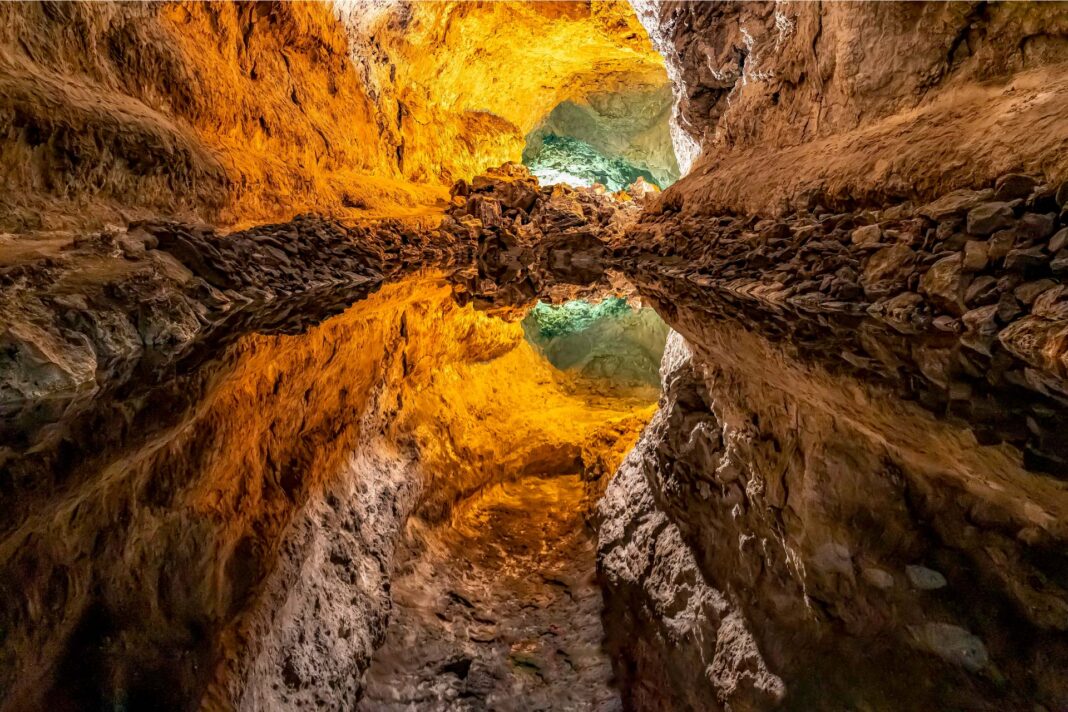
Cueva de los Verdes forms part of a lava tube created during the eruption of La Corona volcano. Today, a section of its spectacular interior has been adapted to allow visitors to venture deep inside and explore its auditorium and a geodynamics laboratory.
Stepping inside the Cueva de los Verdes is reminiscent of Jules Verne’s Journey to the Centre of the Earth, as if you were walking into the planet’s interior. You’re surrounded by vast, solidified lava flows that, around 23,000 years ago, were rivers of fire carving through an apocalyptic landscape. Part of an eight-kilometre gallery, the cave opens into soaring vaults up to fifty metres high and subterranean lagoons, alongside narrow passages and a descent of up to forty metres.
Recognised for its immense geological value, only one kilometre of the tube is accessible to the public. In 1964, Jesús Soto, a close collaborator of César Manrique, designed the lighting and ambient sound, ensuring the natural environment remained undisturbed. As you walk through, the rock’s molten textures appear almost sculpted, and the walls reveal a vibrant mineral palette: deep reds from iron oxide, yellows from phosphates, whites from calcium carbonate, and the stark black of lava and basalt.
The Cave’s name is said to come from a local family, the Verdes, who once used it to shelter livestock. Long before that, it served as a refuge for islanders fleeing Barbary pirate raids in the 16th and 17th centuries. It lies within the same volcanic tube that extends down to the Jameos del Agua. Both sites are in the municipality of Haría and are designated as Centres for Art, Culture and Tourism (CACTs).
Beyond its enormous geological value, the cave is a world-class cultural venue. Its natural ventilation and extraordinary acoustics have created an intimate auditorium which hosts international artists as part of the CACT and Cabildo cultural programmes.
Tucked away beside the auditorium, hidden from view, sits one of the three modules of the Lanzarote Geodynamic Laboratory (LGL). The others are located at Jameos del Agua and Timanfaya. Here, sensitive instruments monitor the island’s subterranean life around the clock, tracking ground deformation, tremors, gravity shifts, and changes in pressure and temperature that could signal seismic activity.
Jameos del Agua marks the end of the system’s overland section, but the tube continues a further 1.6 kilometres beneath the sea at a depth of 64 metres, forming the Túnel de la Atlántida. This geological and biological treasure offers scientific research a rare window into an undisturbed ecosystem that is home to at least 38 endemic species.