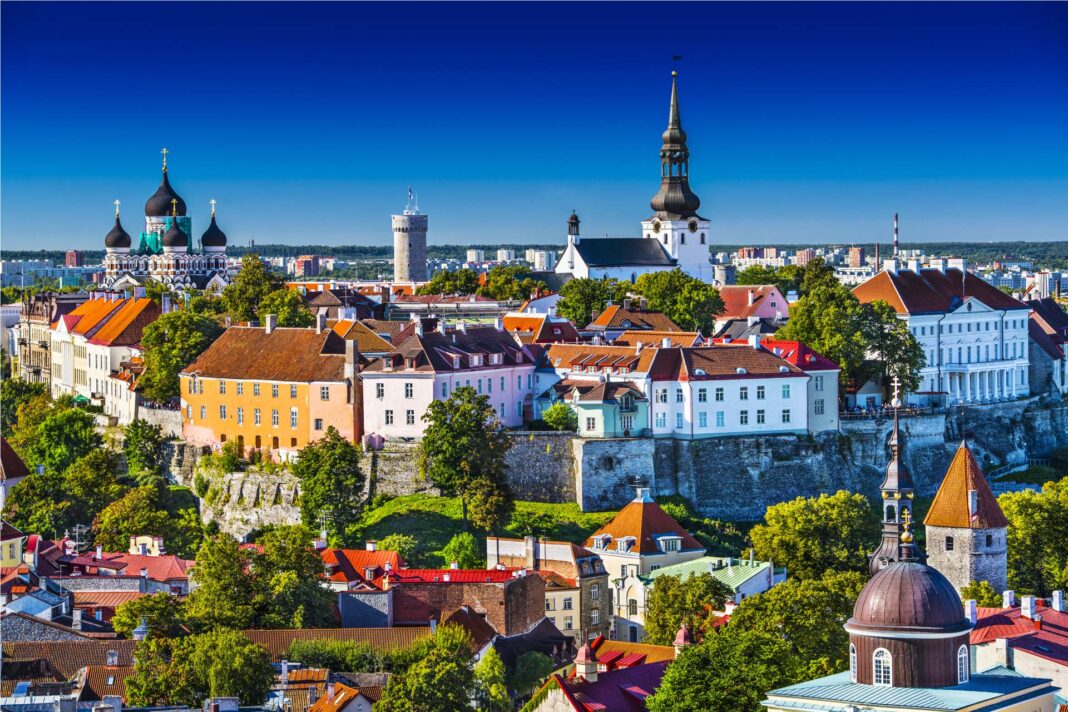
Estonia’s capital perfectly embodies the country’s dual identity straddling medieval history and digital modernity. Its tranquil, uncrowded streets and stunning natural beauty put it high on any city-break wish list.
Estonia’s winters are truly freezing; temperatures dip between -5oC and -15oC, and daylight is scarce. But provided you wrap up warmly, it’s the perfect season to discover the real Tallinn. It’s also when accommodation is up to 40% cheaper and exploring is hassle-free. On clear nights, you might even catch a glimpse of the Northern Lights.
The frozen Gothic architecture of Vanalinn, the city’s Old Town, feels like stepping back in time. A blue-tinged glow accompanies you around the cobbled streets, winding between medieval walls and towers. Expect silence, the scent of chimney smoke, and the sight of steaming mugs of glögi (spiced mulled wine) through the frosted windows of cosy cafés.
On the outskirts, monumental buildings and concrete blocks still bear traces of the Soviet era. These districts sit on the fringe of what is known as the ‘Silicon Valley of the Baltics’: A new Tallinn, defined by contemporary architecture, tech start-ups, designer cafés, free Wi-Fi, and a surprising Nordic, tech-driven energy.
A short two or three-day city break is plenty to get a good feel for Tallinn. Must-sees include the Vanalinn old quarter, a UNESCO World Heritage Site, the medieval walls, the Viru Gate, Raekoja plats (Town Hall Square), and Oleviste Kirik (St. Olav’s Church), whose 124-metre tower offers a spectacular view over the city of spires.
Toompea Castle, now the Estonian Parliament, stands in the Toompea district in central Tallinn alongside the Alexander Nevsky Cathedral with its notable black onion domes and Moscow-inspired silhouette. Art lovers should head to Kesklinn for the Art Museum of Estonia, housed in the Baroque Kadriorg Palace, set in a beautiful park. Nearby, the contemporary-architectural Kumu Art Museum is one of the finest galleries in northern Europe, combining classic Estonian art with avant-garde exhibitions.
Other highlights include Telliskivi Creative City, a former industrial complex reinvented as an artistic hub with murals, galleries, cafés, and local design shops. Right next door is Fotografiska Tallinn, the Baltic version of Stockholm’s renowned photography museum.
Should you have a couple more days at your disposal, there are some spectacular sites worth visiting within a 100 km radius. It’s best to hire a car to visit places like Lahemaa National Park with its frozen forests, partially iced-over waterfalls. Or call in on grand 18th-century manor houses such as Palmse, Sagadi, and Vihula, and traditional fishing villages like Altja or Käsmu, where the Baltic Sea resembles a sheet of glass.
Near the Russian border, explore Ida-Virumaa and the amber mines. Don’t miss the Amber Museum in Narva-Jõesuu. In Rakvere, visit a dramatic reconstructed medieval castle and a fascinating interactive museum. The Pakri cliffs in Paldiski deliver a feast of natural beauty: ice, forest, wind, and open sea. And on the island of Saaremaa, Kaali Lake fills a meteorite crater formed approximately four thousand years ago.
If you’re keen to experience Estonian winter festivals and traditions, time your visit to coincide with one of the following: 13th January is Orthodox New Year, featuring special liturgies in some churches. 24th February marks Independence Day, celebrated with parades, concerts, and a patriotic atmosphere in Toompea and Freedom Square. Or Vastlapäev (Shrove Tuesday/Carnival), traditionally celebrated with sledging, hearty stews, and the typical cream-filled bun, vastlakukkel.
Must-do winter experiences include ice skating in Town Hall Square or Kadriorg Park, and the full cold-to-warm ritual of sauna, plunge, and spa at Kalev Spa, in the city centre, or Iglupark, on the harbour.
Essential Information
Documentation: Spanish/EU Nationals: DNI/Passport. British Nationals: Passport.
Language: English is widely spoken in almost all situations. Basic Spanish may be available in hotels and tourist areas.
Healthcare: EU Nationals: European Health Insurance Card (EHIC). British Nationals: GHIC (UK Global Health Insurance Card). Private travel insurance is strongly advised.
Currency & Payments: Euro (€). Visa, Mastercard, Apple Pay, and Google Pay are widely accepted.
Driving: Drive on the right. Spanish and British driving licences are valid.