
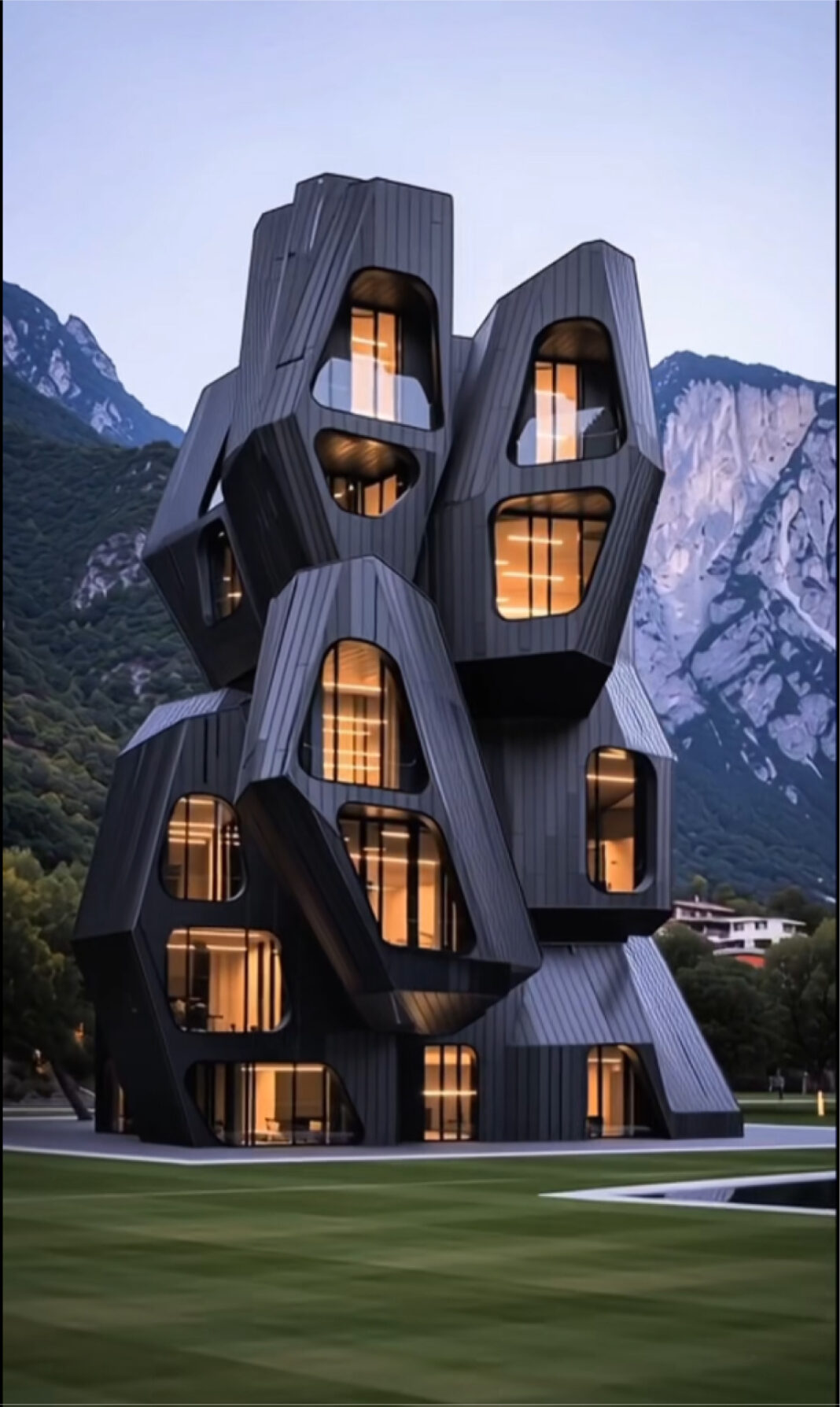
It’s called Neocosmic Architecture, and it does not exist in physical form beyond screens, renders and the metaverse. For now. The concept has been spearheaded by digital designer and artist Iosif Gkinis, who specialises in AI-driven design. It challenges traditional architecture by claiming the digital realm as a legitimate field of creation, generating its own aesthetic spaces rather than merely serving as a visualisation tool for conventional architecture.
Every movement has an origin story, and Neocosmic architecture’s is Villa Saraceni, a digitally created fictional house set in Sicily. Conceived as a purely visual dream, with no intention of ever being built, it caused confusion on social media, with many assuming it was real. It isn’t.
There is no official manifesto and no recognised Neocosmic Architecture school, but its spirit is very much alive. Several cutting-edge studios and practices are exploring its identity at the intersection of algorithmic and generative architecture, AI digital morphogenesis, cosmic simulation, immersive materials, and ecological non-human consciousness. Nor has it appeared out of nowhere; it has clear precedents: random generation as spatial poetics (Christiane Robbins, in the 70s, imagined space as a process, not a form); architecture as a living organism; the poetics and aesthetics of data (Refik Anadol); the intelligence of the void; and the aesthetics of cosmic matter.
Neocosmic Architecture truly comes into its own in its ability to inspire, experiment and push the boundaries of architectural design. Its environments are spectacular and dramatic yet fluid, imbued with a distinctly cosmic, monumental atmosphere.
Conceptually, Neocosmic is defined as neo-Gothic organicism in the digital cosmos, or, alternatively, virtual expressionist organicism. Aesthetically, its distinctive hallmark is its sheer monumentality, dramatic scale, verticality, mysticism, and sublime darkness, resulting in spaces that feel almost sacred.
It features a contrast between a dark, tectonic, mineral, monolithic exterior (slate, concrete, metal) and a warm, human interior (wood, golden light, soft textures), balanced by a touch of Nordic minimalism. Interiors are sober and uncluttered, with essential furniture pieces and neutral palettes lifted by warm accents. Their measured elegance counterbalances the mass of the outer shell, echoing the contrast between the stark exteriors and the gentle amber glow that floods and ‘constructs’ the interiors.
Equally significant is its iconic monumental scale. These buildings are conceived as urban sculptures, landscape landmarks, or cosmic symbols. Their interiors, too, are designed as landscapes rather than mere functional spaces. They evoke caverns, frozen waves, interior mountains, and geometric forms that seem impossible today but may be plausible in the future.