
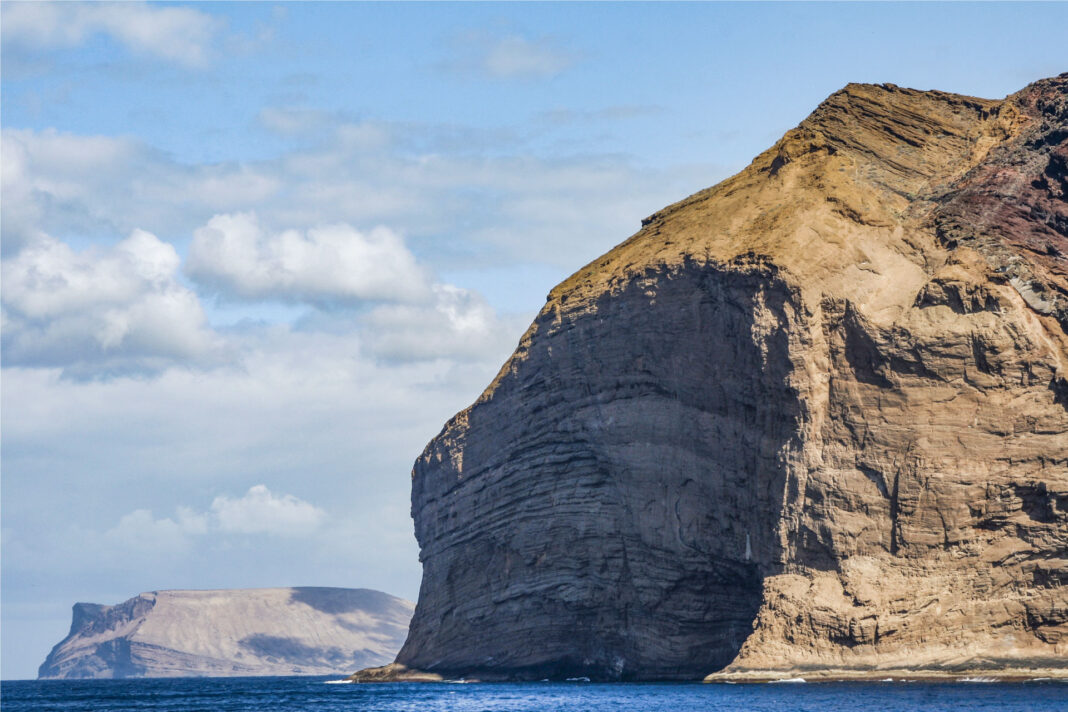
The cluster of islets visible from viewpoints in northern Lanzarote is one of the Canary Islands’ most precious wildlife reserves, a protected sanctuary for numerous endemic species on land and at sea.
Far from being a handful of barren rocks, the Chinijo Archipelago Natural Park is a richly varied territory that is home to numerous protected species, many of which are under threat of extinction.
Aside from La Graciosa, the only inhabited island, the rest of the archipelago is strictly off limits. Only authorised scientists are allowed to land on the Integral Nature Reserve islets – Montaña Clara, the eastern and western Roques, and Alegranza. This protected area, which also encompasses the Risco cliffs, Famara, and the Jable sand plains, has been designated a Special Protection Area for Birds since 1994, and the 700 square kilometres of surrounding waters comprise the largest marine reserve in Europe.
Conservation on the ground is led by Tragsa, while the environmental departments of the Lanzarote Cabildo and the Canary Islands Government share surveillance duties. Organisations including WWF/Adena, SEO/BirdLife and GREFA regularly study and monitor the park’s biodiversity, alongside periodic work from the Spanish Institute of Oceanography, the EOMAR research group at ULPGC, the Seabird Ecology Lab at the University of Barcelona, and independent scientists like Claudia Schuster.
Two major threats loom over this fragile territory, and account for its rigorous protection: human activity, especially on La Graciosa, and the steady influx of ocean-borne plastics and rubbish. Although the latter is a global problem, recent studies highlight its impact on the Chinijo Archipelago.
Alicia Herrera Ulibarri, a lecturer at the University of Las Palmas de Gran Canaria, has been researching plastics and microplastics in the Canary Islands since 2015. Referring to her work on Alegranza, she notes, ‘In 2020 we removed 3,667 items; 321 kilos in total, of which 97.7% were plastics. 66.7% of labelled bottles came from Asian countries, which clearly points to maritime traffic as the source.’
Herrera adds that microplastics carry chemical pollutants and living organisms that emit dimethyl sulphide (DMS), the ‘smell of the sea’ that shearwaters and storm petrels detect with their chemoreceptors. Drawn by that signal, they ingest microplastics, mistaking them for food, and, along with other species, suffer entanglement, asphyxiation and malnutrition. They feel fed, but their stomachs are full of plastic debris.’
The Canary Current flows south-west, positioning the archipelago as a global hotspot for the build-up of ocean- borne debris. Alegranza is the first island in its path, leaving nesting seabirds such as the Cory’s shearwater and the European storm petrel particularly vulnerable to this tide of drifting waste.
Eleonora’s falcon, another protected species, is monitored through ringing and satellite tracking, while researchers also map nesting sites and migratory drift. Each May, these falcons arrive from Madagascar to intercept the spring passage of small migratory birds flying from Europe to Africa. The seeds eaten and carried by these migrants help explain the Chinijo Archipelago’s remarkable botanical diversity.