
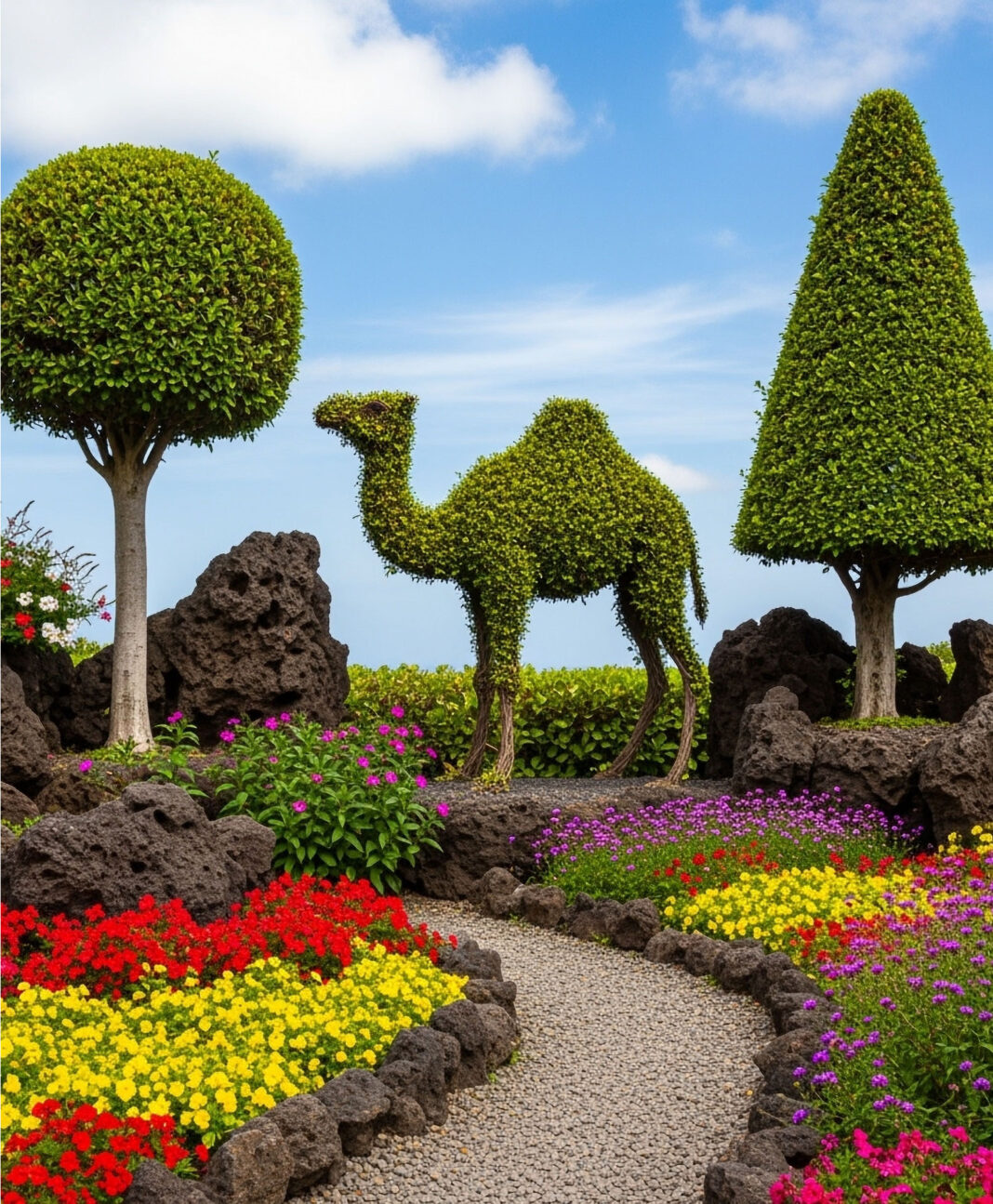
Sculptural pruning goes beyond a practical gardening chore. It is a blend of skill and artistry in which the gardener shapes plants into familiar forms and celebrates their natural beauty.
Sculptural pruning brings together art, technical skill and respect for the environment. Unlike conventional pruning, which primarily focuses on controlling growth and keeping plants healthy, it is an artistic process in which the gardener sculpts the foliage to give form, character and a strong visual presence, transforming each plant into a living work of art.
Form and structure: The plant’s natural silhouette is emphasised. In species such as Agave americana or Euphorbia canariensis, secondary leaves or branches are carefully removed to accentuate vertical lines or sweeping curves. In shrubs like Ficus benjamina or Ficus microcarpa, both common in the Canary Islands, the canopy and overall volume are carefully shaped while maintaining the plant’s vitality.
Harmony and balance: After pruning, the plant should be not only healthy but visually balanced and attractive. Consideration is given to how light and shadow will affect the new shape and how it will integrate with the rest of the garden, such as rocks and surrounding plants.
The ideal time for artistic pruning is winter, but it’s worth remembering the joy lies not in the destination, but in the creative journey. It’s an ongoing process rather than a one- off cut, demanding patience and long-term vision. Beyond private and public gardens, effective creative pruning can be seen at work in tourist and hospitality spaces where identity and serenity are key. It is also used to great effect in arid or volcanic environments, where native plants create dramatic contrasts with the dark rock. The tools of the trade are standard: secateurs, fine saws and sharp knives, which must always be disinfected before each use.
Sculptural pruning has deep roots in ancient Eastern gardening traditions that combined art, botany and philosophy. In Europe, the art of topiary emerged during the Renaissance and Baroque periods, which involved clipping shrubs and hedges into geometric, animal or architectural shapes.
The 20th century saw the rise of modern landscape design and environmental art, and a revival of the ethos championed by those Eastern practices. Combined with the precision of topiary and a new ecological awareness, the modern gardener emerges as nature’s creative collaborator, not its master.