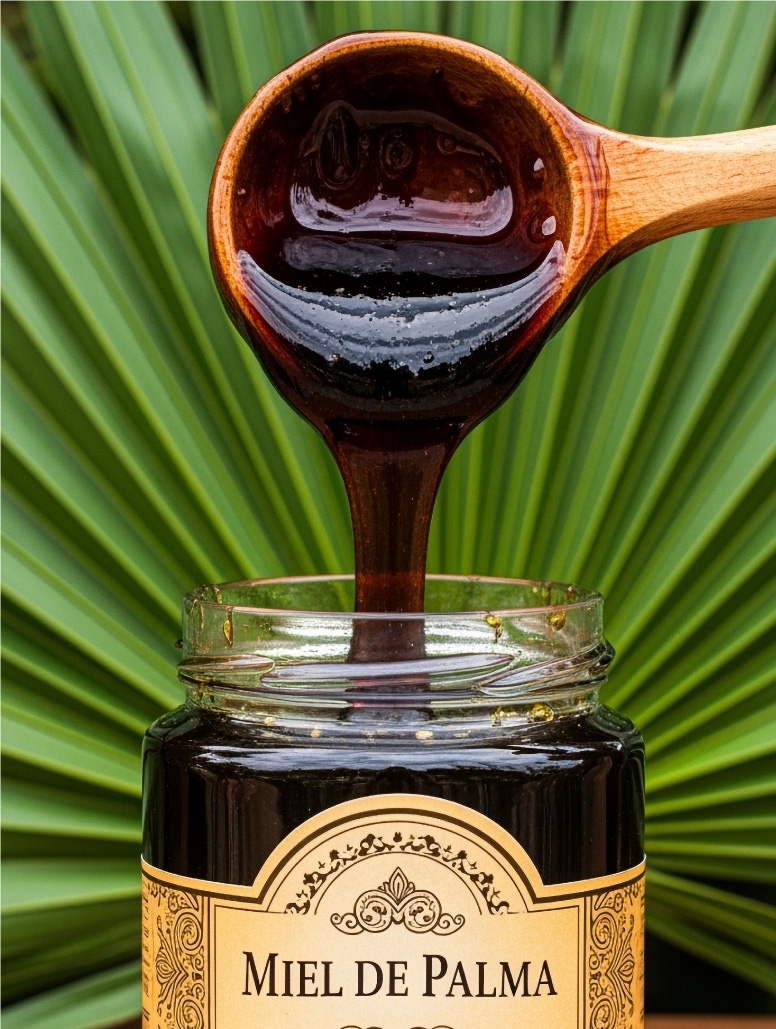
Palm syrup (miel de palma) is traditionally obtained from the sap of the Canary Island date palm, Phoenix canariensis. It originates exclusively from the island of La Gomera, where barely a dozen small producers still make and sell it. Its natural, artisanal production dates back to pre-Hispanic times and the island’s aboriginal inhabitants. This ancient origin, together with its nutritional value, texture, aroma and flavour, makes it one of the Canary Islands’s true culinary treasures.
Miel de palma has a deep, toasted sweetness and a remarkable purity. It’s rich in essential minerals and trace elements yet contains no additives or preservatives. A study published in 2016 by professors Alberto Castilla and Pedro Abreu from the University of La Laguna concluded that its nutritional properties surpass even those of traditional bee honey.
Moreover, palm syrup—also known as palm honey—is lower in calories than conventional sugar, containing around 75 grams of carbohydrates per 100 grams, compared with the 99.8– 100 grams found in white sugar. That’s another argument in favour of this natural sweetener, which nonetheless remains a hidden gem, rarely seen outside the islands.
Traditionally, it has been used to accompany desserts and cheeses, but its versatility and silky consistency have inspired many chefs in contemporary Canarian cuisine to explore its potential further and incorporate it as an ingredient in both sweet and savoury dishes.