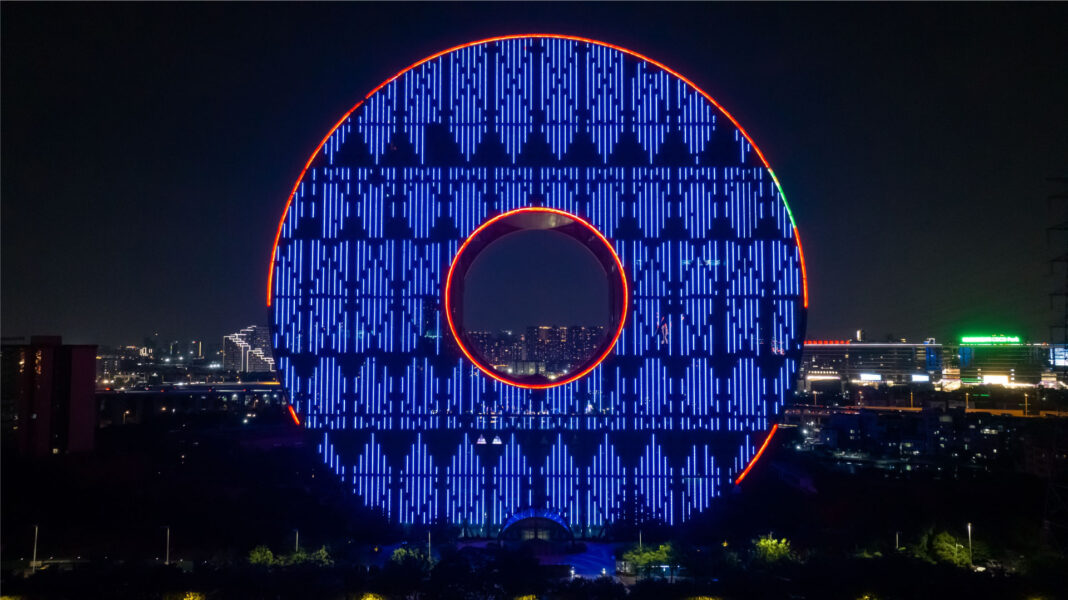
Designed by Italian architect Joseph Di Pasquale, the Guangzhou Circle is widely described as the world’s tallest circular building. Inaugurated in 2013, it soon attracted global attention, with CNN naming it among the planet’s ten most fascinating buildings.
First proposed in 2008, the Guangzhou Circle represents a bold departure from the familiar Western skyscraper template. Instead of a vertical block, it forms a vast ring with a dramatic central void. The building rises 138 metres over 33 floors, with around 85,000 m² of floor area and a central opening about 48 metres across. The design draws on the ancient Chinese jade bi disc, a Neolithic ritual object traditionally associated with Heaven. When mirrored in the waters of the Zhujiang (Pearl) River, the circle becomes a double form resembling the number “8”, a symbol of prosperity deeply rooted in Chinese culture.
Constructing such a unique building presented considerable engineering challenges. The structural concept was developed and tested in the wind tunnel at the Politecnico di Milano, while the final calculations and checks were conducted at the South China University of Technology. Today, the Guangzhou Circle has become an iconic landmark on the city’s skyline.
Di Pasquale has described the shape as naturally aligned with Chinese ways of seeing and understanding, closer to characters in Chinese writing than an alphabet. He also links it to the Renaissance challenge of ‘squaring the circle’, with the two circular façades supporting internal floors that ‘square’ the perfect circumference outside to create an orthogonal and fully functional interior.
The main hall sits in the heart of the central void, a dramatic space where architecture and engineering converge. With 25-metre cantilevers extending from the ring, the building appears to hover, seemingly defying gravity.
It’s also very much a working building, serving as headquarters for the Hongda Xingye Group and the Guangdong Plastic Exchange (GDPE), alongside offices for numerous other firms. A reinforced-concrete frame supports two vast circular façades, wrapped in glass to draw in daylight. Rather than leaning on a sustainability label, the design lets the central void take the lead, bringing light deep into the building and shaping the way the spaces flow.