
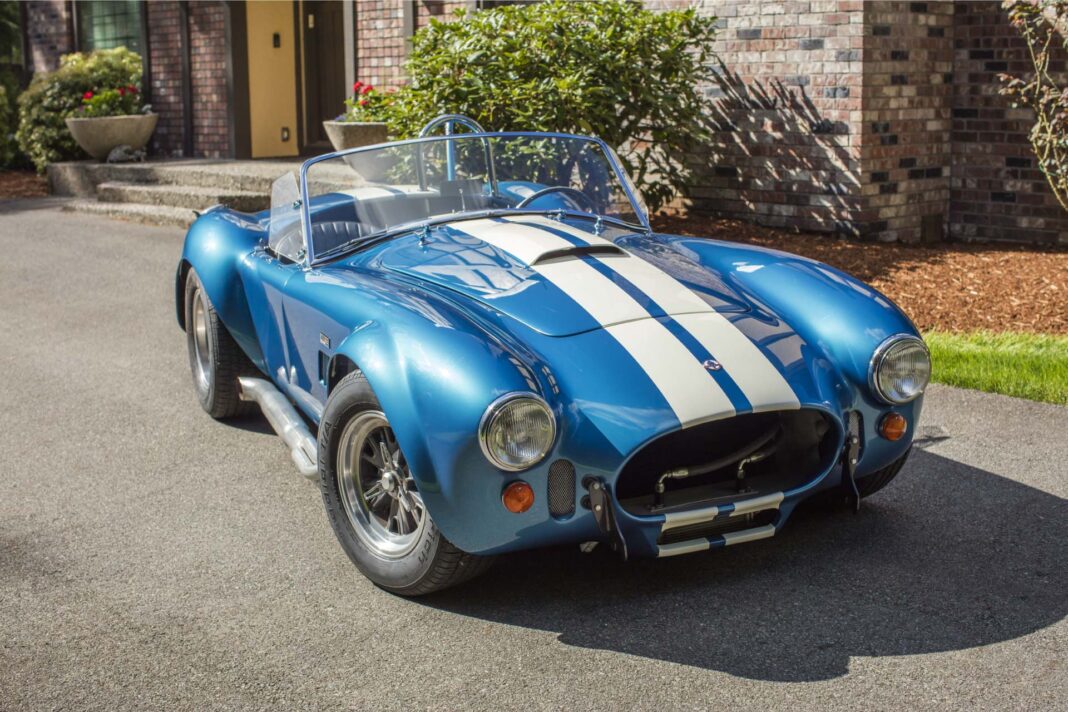
Continuation cars are modern recreations built by the original manufacturer, or under official licence, to the original model’s standards and blueprints. The aim is to capture the spirit of an icon, but with the fit, finish and precision of contemporary craftsmanship.
If you spot an AC Cobra, a DB5 Goldfinger, or a 1957 Jaguar XKSS out on the road, fear not, you haven’t slipped into a time warp; it could be a beautifully restored classic, a ‘restomod’, or perhaps a continuation car. Increasingly, manufacturers are reviving and updating their most legendary models for a new era.
Some marques hover at the edge of the concept, without using the label. Lamborghini, for instance, offers meticulous, ground-up restorations of the Miura (1966–1973). Others, like AC Cars, are building brand new Cobras based on the Cobra GT Roadster and Coupé blueprints, while also producing continuation versions of the MKIV from the 1980s and 1990s, itself a later take on the original 1960s Cobra. Shelby, licensed to build Cobras in the US, follows suit.
As electric vehicles expand their reach, continuation cars are trending in 2026 because they ride a wave of nostalgia, a yearning for the thunderous V8s, V12s or flat-six boxer combustion engines. Brands are tapping into the emotional pull of resurrecting mythic machines, elevated to objects of desire on social media. The catch, of course, is that they remain far beyond most wallets.
Aston Martin’s DB5 Goldfinger is a textbook example. The brand has revived James Bond’s DB5 (1965) and officially added the ‘continuation’ tag. To the 900 original DB5s, Aston has added a further 25, hand-assembled at Newport Pagnell in Buckinghamshire. Each requires around 4,500 hours of craftsmanship and carries the ‘modest’ price tag of roughly €3 million.
Jaguar Classic has been just as active. By January 2026, it had completed production of three continuation series, reviving icons such as the XKSS, the D-Type and the Lightweight E-Type. The C-Type remains in production with each unit built to the exact specifications of the 1953 Le Mans winner, right down to the 3.4-litre inline-six XK engine with triple Weber 40DCO3 carburettors, and the pioneering Dunlop disc brakes that debuted in that racer.
To give a sense of the sums involved, Jaguar built six Lightweight E-Types at an approximate price of €1.3 million each. The XKSS run totalled nine cars at around €1.2 million each. Twenty-five D-Types were produced at roughly two million euros before tax. For the eight C-Types, estimates sit somewhere between €1.15 million and €2.3 million each. All were snapped up by a select group of collectors.