
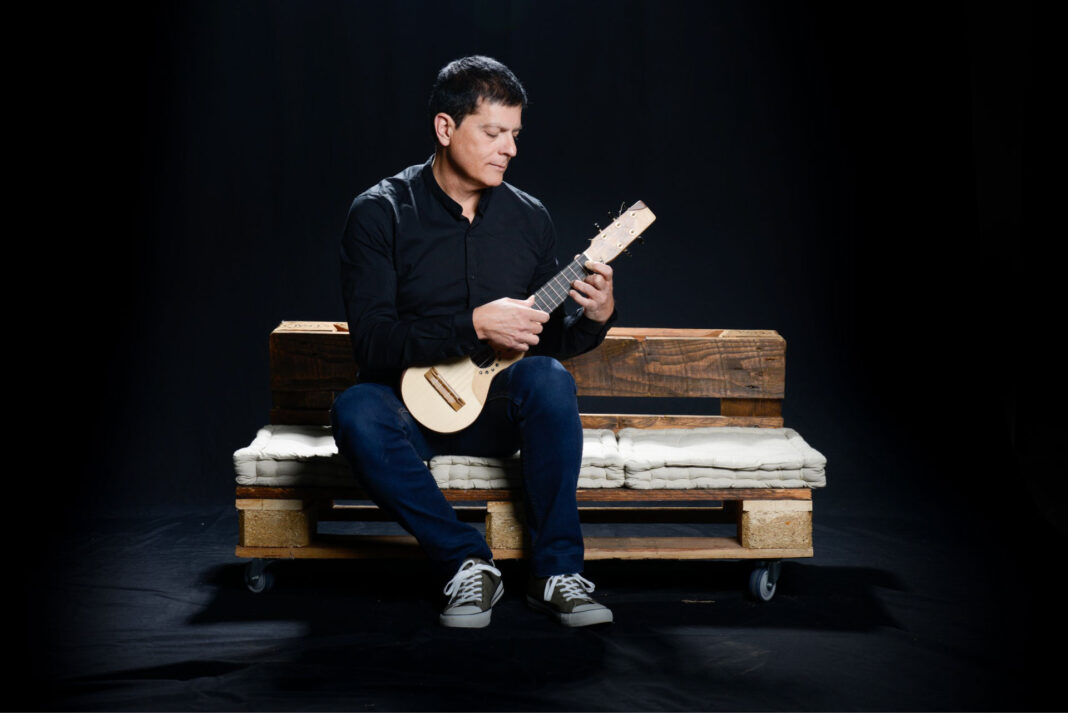
“Being appreciated at home means the world to me”
Life’s rich tapestry and the timple have fulfilled his dreams in a career defined by experimentation. With a new album, a stage show, and an endless urge to create, Benito Cabrera’s next chapter is already taking shape.
Looking back at your early dreams to where you are now, what’s the verdict? Dreams fulfilled, shelved, surpassed…?
‘Quite a few have come true, but I’m not one for setting rigid goals. I prefer to let life flow and take what it offers. I never imagined I’d dedicate myself to the timple, but it has allowed me to fulfil my dreams, and then some.’
You’ve taken the timple around the world, brought it into the symphonic arena, explored its sonic heritage… Yet it’s essentially the same instrument. Could an evolution, such as an electric timple, take it to another level?
‘There’s already an electric timple, built by luthier David Sánchez, which is in the Museo del Timple in Teguise. We’ve experimented with it, but it needs a lot more work, because its register is very high-pitched and distortion can become shrill.’
‘José Antonio Ramos, a long-time collaborator, is wonderfully bold and created a MIDI timple which I tried. But it’s still uncharted territory demanding hours of work. I prefer to stick with the acoustic, which sits more naturally with my sound. It might be a path worth exploring, but I’ll leave that to others.’
“A sheet of paper. It gives me more scope”
Without the timple, what other versions of Benito Cabrera might have been possible?
‘Music has always mattered hugely in my life, but I loved the guitar and wanted to be a concert performer. Then the timple came along. Before that, there was Psychology, which I almost finished. It’s given me a useful grounding for managing groups and navigating social relationships. Medicine also crossed my mind… Dr. Benito Cabrera… No. I can’t see it now.’
You mentioned you were immersed in a project. Can you give us a preview?
‘Several things, actually. I’m composing a new repertoire titled Atardeceres, due out within a year. It’s a simple format for timple and guitar, with my regular partner, Tomás Fariña. There’s a thread of continuity with my last album, Islópolis, but it’s a more intimate concept. More immediately, we’re taking Islópolis to venues across the Canaries and several European cities.
I’m also working on a stage production, De jarana, a fusion of music and movement. It combines dance and physical expression, led by Jep Meléndez, with timple, guitar and a few other instruments. In short, it’s all about experimentation. That’s what preoccupies me, occupies me, and fulfils me in equal measure. I’ve tried it with the Tenerife Symphony Orchestra, with Cristina Ramos, and, in the past, with Los Sabandeños… It’s how you build momentum, and it’s also a form of personal growth.’
If I asked you to write down one of your dreams, would you need a sheet of paper or a musical stave?
‘A sheet of paper. It gives me more scope. Beyond making music, I enjoy writing and communicating.’
Do emerging talents or established artists ask you for advice? What do you tell them?
‘I have an excellent relationship with fellow musicians. We collaborate, we feed off one another, we share. The atmosphere is very positive, and it’s more about exchanging ideas than giving or asking for advice. I also keep in closer touch with those of my generation: Domingo ‘El Colorao’, José Vicente, Germán López…’
Do you feel appreciated by home audiences?
‘Generally speaking, yes. I’ve spent many years making a living from music in the Canaries, and music is a delicate business at the best of times. People tend to look abroad first. But despite that local short-sightedness, yes. I do feel appreciated at home.’