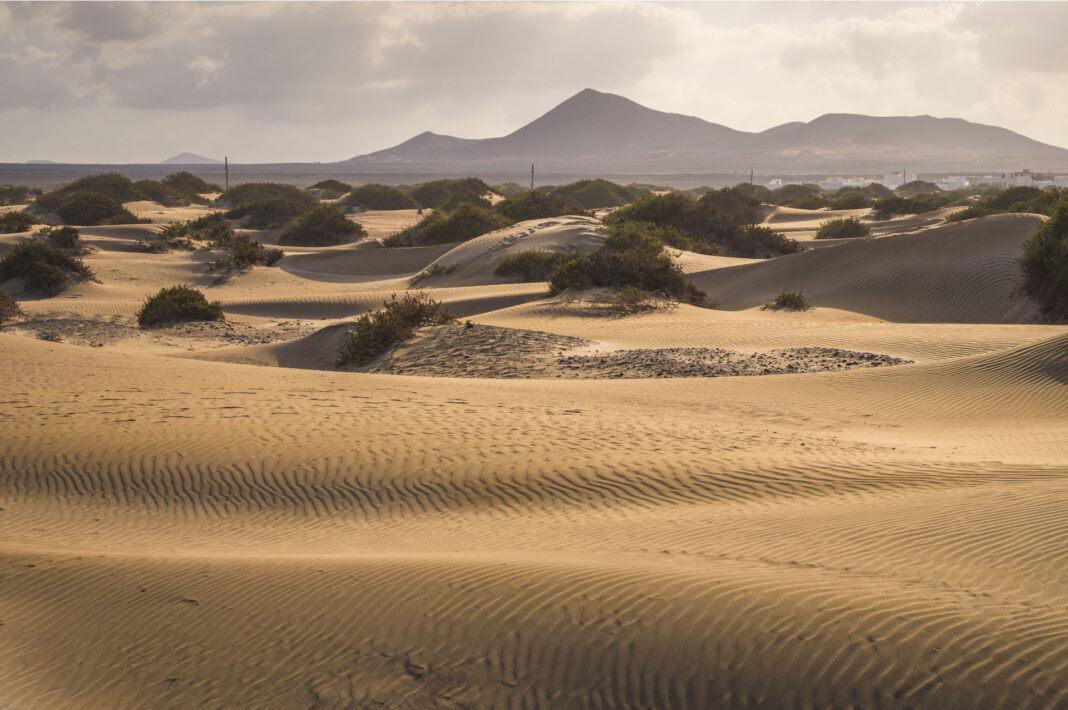
The vast sweep of jable that stretches inland from Famara is a protected habitat known for its ‘invisible biodiversity’. After plentiful rainfall, this remarkable sandy terrain transforms into a meadow bursting with life and colour.
The Chinijo Archipelago Natural Park extends into Lanzarote, bringing together two distinct ecosystems: the Risco de Famara cliffs and the jable sands, which reach as far as Caleta del Caballo and several kilometres inland. This territory is also designated a Special Protection Area for Birds (ZEPA) and a Site of Geological Interest (LIG).
The Risco encompasses beach, near-vertical rock faces, and sandy coves tucked along its inner edge. Among its most notable wildlife are Eleonora’s falcon, Cory’s shearwater and other seabirds common to the nearby islets. It is also home to lizards and a wide variety of invertebrates, with 1,455 species recorded to date.
The volcanic jable sands form a sedimentary habitat of remarkable ecological value, home to a resilient and largely hidden biodiversity. After generous rains, the terrain shifts dramatically: a vast, dormant reserve of diaspores — seeds, fruits and sun-dried fragments buried in the sand — awakens, transforming the pale plains into green meadows. This explosion of life is spectacular but fleeting.
In dry spells, the jable can look almost empty at first glance, with most life staying low to the ground, making birds, lizards and insects easy to miss. Ethnobotanist Jaime Gil refers to the ‘invisible biodiversity’ of the jable, where around 150 plant species have been recorded with striking variations in density. While some areas seem barren, others can hold concentrations of up to 35 different plant species per square metre.
Together with agronomist Marta Peña, Gil has published A Visual Guide to the Vascular Flora of the Lanzarote Biosphere Reserve, a field notebook created for members of the environmental association Viento del Noreste, founded in 2015. Alongside Desertwatch.org, they monitor, clean and protect this territory, raising awareness of its environmental value, and sharing educational material through their website.
Palaeontologist Antonio Sánchez Marco describes the jable as ‘a storehouse of information on the history of life’. It gathers what settles within it and gradually transforms it, preserving organic traces that eventually become fossils, even as the sands themselves continue to shift. However, the environment is under pressure. Viento del Noreste and Desertwatch.org also highlight the main threats to this fragile environment, including illegal extraction of sand and gravel, unleashed dogs, fly-tipping, abandoned farmland, vehicles driven off marked tracks, and off-road activities such as motocross, quads and buggy tours.