For centuries, Ermita de Las Nieves has quietly received prayers for rain and the footsteps of devout pilgrims. Nearly 600 years on, it remains an active place of worship, with its main celebrations held each August.
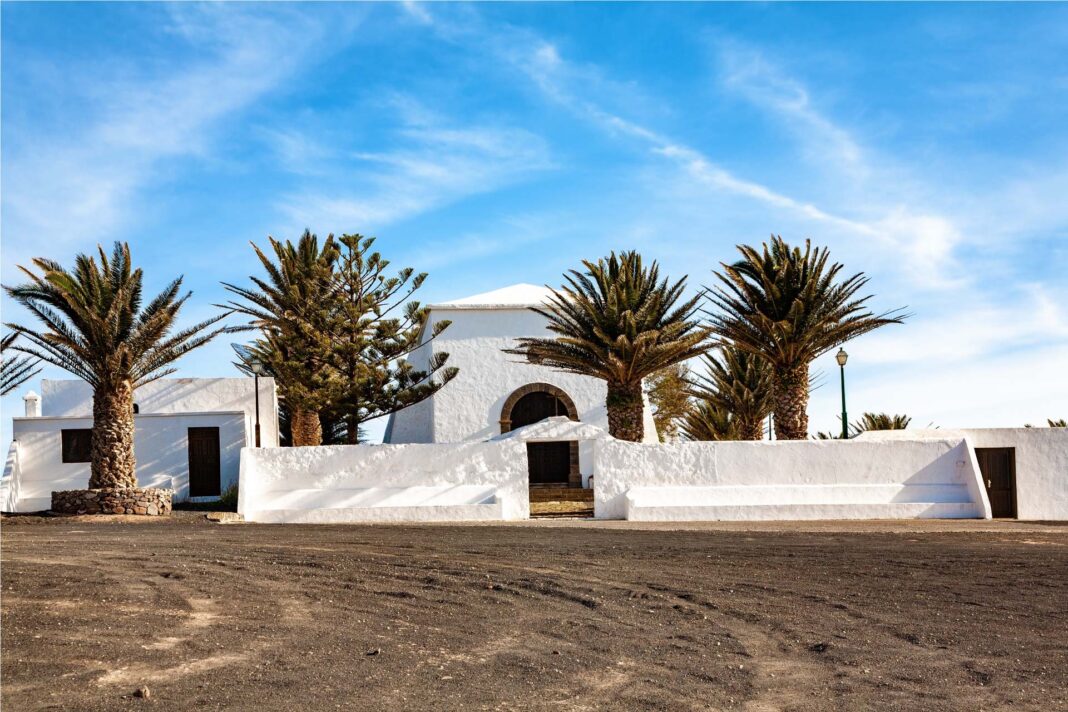
Perched on the edge of the Famara cliffs and often shrouded in mist, a small white chapel emerges, flanked by palm trees. This is the home of the Patron Saint of Lanzarote, Nuestra Señora de las Nieves (Our Lady of the Snows). Although her official title was granted on 17 March 1725, local devotion to her began far earlier.
According to Francisco Hernández, official chronicler of Teguise, an early temple stood on this site as far back as 1427. By the late 1600s, devotion to the Virgin had spread through the valleys leading up to the mountain, and by the early 1700s, her shrine had become Lanzarote’s most important Marian sanctuary.
Hernández adds that the whole island would flock to the clifftop chapel seeking relief from ailments and solace for family woes. In the harsh reality of rural life on Lanzarote, the Virgin became, for many, the mother, friend and confidante they could not find elsewhere.
For centuries, the chapel was the focus of prayer and pilgrimage. Every four years, the statue of the Patron Saint was carried down to Teguise, a tradition documented for more than two hundred years and widely regarded as the origin of the pilgrimage that draws thousands of devotees every August. The building was enlarged and renovated in the mid-1960s and reopened in 1972.
Throughout the rest of the year, the chapel attracts visits from hikers and cyclists, though its doors are usually closed. Father Juan Manuel Molina Benítez, parish priest of several churches in northern Lanzarote and La Graciosa, has served Las Nieves for four years. ‘We hold Mass here on the second Friday of every month, at 5 pm,’ he explains.
August is when it comes into its own. ‘On 5 August, or the Saturday before, depending on the calendar, we celebrate a solemn Mass at noon in honour of the Patron Saint, followed by a thirty-minute procession around the chapel, weather permitting. If not, we stay under the portico.’
‘The Saturday before is the romería,’ he continues. ‘Pilgrims arrive on foot, many fulfilling vows or doing penance. They bring offerings, which go directly to the charity Caritas. It is a restrained and deeply religious gathering, characterised by incense and devotion rather than street stalls and spectacle.’ The Pilgrims’ Mass follows at 7.30 pm, and the day before, a devotional service includes the traditional opening