
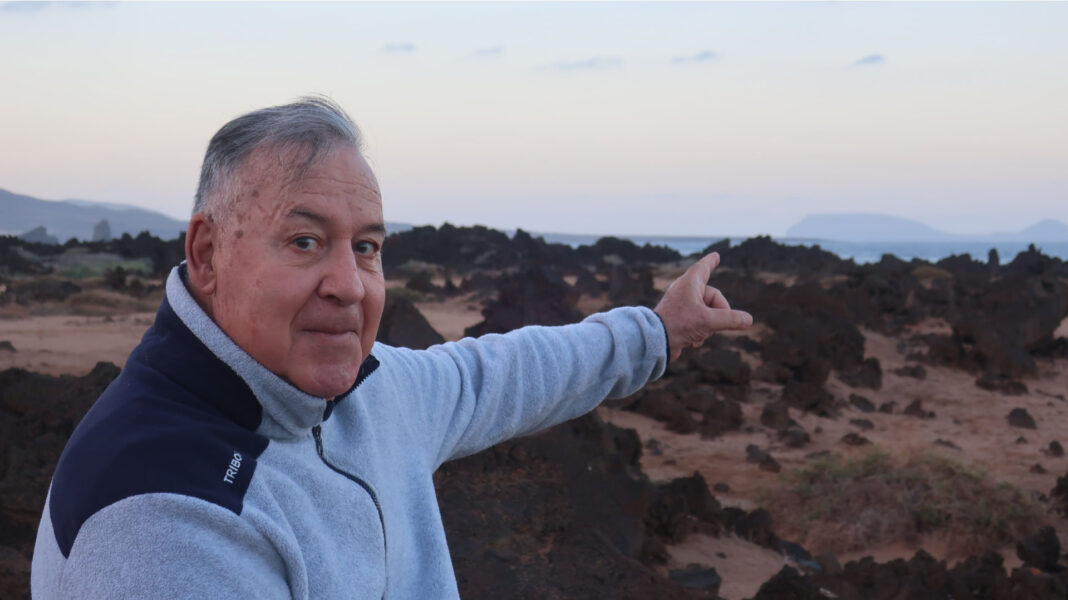
Agustín Pallarés Lasso spent his childhood on Alegranza, the tiny island he describes as ‘a world of my own, a wonderful place,’ where he roamed freely, greeted dolphins, and tended his own shearwater nest.
“Alegranza was a leap into another dimension”
He first arrived in Alegranza when he was just two months old. His father was the joint lighthouse keeper with the Olivera family. ‘The sea was rough on the day we arrived, and with no jetty then, we had to land at El Veril beach and walk about three kilometres. That stay lasted seven months, my longest spell there.’
Life followed a routine of four-month rotations between the island and Arrecife. ‘By the age of three, and old enough to form memories, I knew Alegranza was a whole different universe. In Lanzarote, I went to school and played with friends and cousins. I enjoyed being there too, with a freedom that children rarely have today. But the place I missed most was Alegranza, it was a leap into another dimension.’
Agustín says he learned far more from his father than he did at school. ‘We had a library at home, and endless time to explore all the knowledge in the world.’ His brother and sister, he recalls, were ‘off doing their own thing, and I was alone in my world, it was marvellous!’
As he grew, so did his adventures. ‘I would go down to the water’s edge to greet dolphins or watch enormous manta rays leaping. It was incredible. I had chores like milking the goats, too. Then I would fish from the rocks. I could tell by the sound of the waves what the sea was like. Sometimes, I would trek to the far side of the island to go beachcombing, hunting for treasures washed up by the tide.’ He would also watch the enormous cargo ships pass by and imagine their mood judging from the angle of their bows. Then there were the shearwaters. ‘In May, at night,’ he remembers, ‘huge flocks would arrive with their distinctive cry. I had a particular nest I’d watch over and care for. I’d even talk to them.’
As an older boy, he remembers the thudding blasts during military exercises, when bombs were dropped on Roque del Este. ‘The planes flew so low over the house we feared they might crash. And when someone fell ill, we’d have to climb a nearby mountain, light a bonfire, and signal with a blanket to call for aid from La Graciosa. Later, a radio transmitter was installed,’ he adds, ‘but it crackled with interference from that same mountain used for the signal fires.’
By eleven, he was heading to secondary school, and that ‘other world’ began to fade, gradually, into memory.